
Faster, Smarter Testing for Salesforce
Automate testing, accelerate releases and eliminate risk – all without writing a single line of code.

Introduction to SwifTest
What is it, and why does it matter?
SwifTest replaces slow, error-prone manual testing with fast, reliable automated Salesforce test execution. In just 30 days, you’ll experience the full benefits of automation – reducing testing time, improving accuracy, and ensuring every Salesforce update runs smoothly.

The Automation Journey
Three Steps to Success
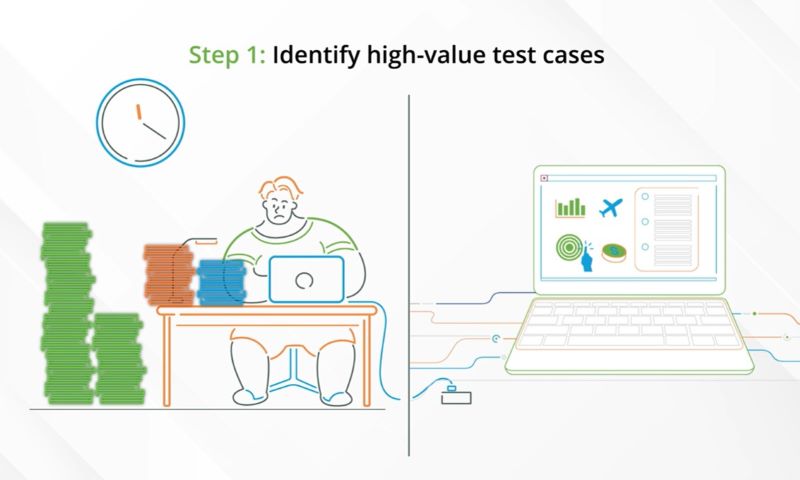
Step One
Identify your most repetitive, high-value test cases
What to focus on:
- Find the manual tests that take the most effort and time.
- Prioritise critical business workflows that must work after every Salesforce update.
Step Two
Automate core test cases and integrate them into your workflows
How automation saves time:
- Turn manual steps into automated test scripts without coding.
- Integrate with Salesforce release cycles to ensure continuous validation.

Step Three
Expand automation, schedule test runs & track results
Scaling for maximum impact:
- Automate more test cases for full Salesforce coverage.
- Schedule recurring tests to catch defects before they impact users.
- Gain clear test results and reporting to track improvements

The ROI Calculator
Illustrate your time & cost savings
See exactly how much time and cost you could save with SwifTest. Answer a few quick questions about your current Salesforce testing process, and our predictive ROI calculator will show you:
- Time saved per test cycle
- Potential cost reduction in QA resources
- How much faster you can release updates
ROI Calculator Inputs
Estimated ROI Savings
Formula:
Total Scripts = (Number of Testers × Test Scripts per Tester)
Script Creation Savings per Script = (2 – 0.5) × Hourly Rate
Script Execution Savings per Script = (1 – 0.1) × Hourly Rate
Total Savings per Cycle = Total Scripts × [Script Creation Savings per Script + Script Execution Savings per Script]
Yearly Savings = Total Savings per Cycle × Test Cycles per Year
Monthly Savings = Yearly Savings / 12
Assumptions: Manual Creation = 2 hrs, Automated Creation = 0.5 hr, Manual Execution = 1 hr, Automated Execution = 0.1 hr
Total Scripts = (Number of Testers × Test Scripts per Tester)
Script Creation Savings per Script = (2 – 0.5) × Hourly Rate
Script Execution Savings per Script = (1 – 0.1) × Hourly Rate
Total Savings per Cycle = Total Scripts × [Script Creation Savings per Script + Script Execution Savings per Script]
Yearly Savings = Total Savings per Cycle × Test Cycles per Year
Monthly Savings = Yearly Savings / 12
Assumptions: Manual Creation = 2 hrs, Automated Creation = 0.5 hr, Manual Execution = 1 hr, Automated Execution = 0.1 hr