
Enterprise applications are expected to do more than function correctly. They must perform consistently, scale under demand, protect sensitive data, support business continuity, and remain resilient in increasingly complex technology environments.
For many organizations, application failure is not a small technical issue. Slow response times can affect productivity. System outages can disrupt operations. Security weaknesses can expose data, create compliance risk, and damage trust. This is why performance testing and security testing are essential parts of a modern enterprise testing strategy.
Functional testing confirms whether an application does what it is supposed to do. Performance and security testing answer two equally important questions: can the application handle real-world demand, and can it protect the business from risk?
Why Reliability Matters in Enterprise Applications
Enterprise systems often support critical processes across finance, operations, supply chain, HR, procurement, customer service, reporting, and compliance. These applications are rarely isolated. They connect with other platforms, exchange data, support multiple user roles, and enable core workflows.
When enterprise applications are unreliable, the impact can spread quickly.
A performance issue in one system may delay order processing, reporting, or customer transactions. A security weakness in one integration may expose sensitive business data. A poorly tested application change may create operational delays during peak usage.
Reliable enterprise applications require more than feature validation. They require a testing approach that evaluates functionality, performance, security, integrations, data flow, and business impact together.
What Is Performance Testing?
Performance testing is the process of evaluating how a software application behaves under specific conditions, especially in terms of speed, stability, scalability, and responsiveness.
The goal is to understand whether the system can support expected business usage. This includes normal activity, peak demand, high transaction volumes, concurrent users, and long-running operations.
Performance testing helps teams answer questions such as:
- How quickly does the application respond?
- How many users can the system support at the same time?
- What happens when transaction volume increases?
- Where are the performance bottlenecks?
- Can the system remain stable during peak usage?
- Will the application scale as business demand grows?
For enterprise teams, performance testing is not just a technical exercise. It is a way to protect business operations from slowdowns, instability, and capacity-related failures.
What Is Security Testing?
Security testing is the process of identifying weaknesses, vulnerabilities, and security risks in a software application, system, or integration.
The goal is to determine whether the application can protect data, enforce access controls, prevent unauthorized actions, and reduce exposure to threats.
Security testing helps teams answer questions such as:
- Can unauthorized users access restricted data?
- Are authentication and authorization controls working properly?
- Is sensitive information protected?
- Are APIs and integrations secure?
- Are there vulnerabilities that could be exploited?
- Does the system support compliance and audit requirements?
In enterprise environments, security testing is especially important because applications often process sensitive customer, financial, operational, employee, and supplier data.
Performance Testing vs Security Testing: Key Differences
Performance testing and security testing are different disciplines, but both contribute to enterprise reliability.
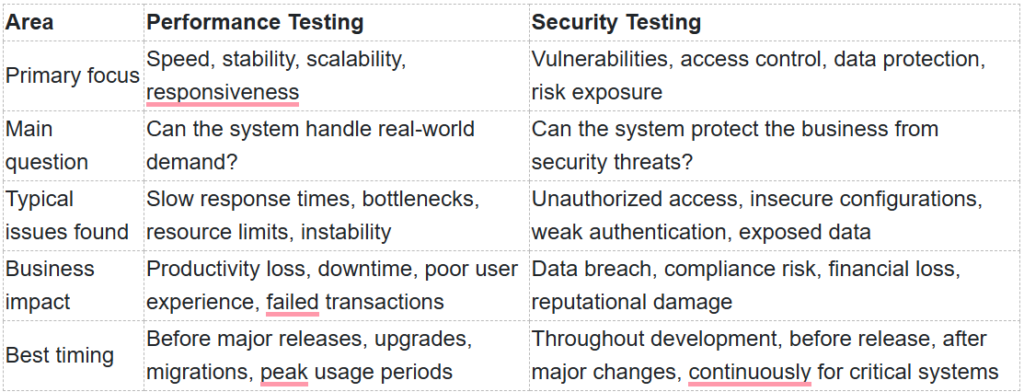
A reliable enterprise application must pass both tests. It should not only work correctly, but also perform under pressure and protect business-critical information.
Why Enterprises Need Both Performance and Security Testing
Many organizations treat performance testing and security testing as separate activities. In practice, they are deeply connected through business risk.
Performance affects business continuity
If an enterprise application becomes slow or unstable during peak usage, business operations can suffer. Employees may be unable to complete tasks, customers may abandon transactions, and downstream processes may be delayed.
Security affects trust and compliance
Security weaknesses can expose sensitive data, violate regulatory obligations, and damage customer or stakeholder trust. The cost of security incidents can be far higher than the cost of preventive testing.
Modern systems are more interconnected
Enterprise applications now rely heavily on integrations, APIs, cloud platforms, third-party services, and data exchange. This increases both performance complexity and security exposure.
Frequent releases increase risk
Agile delivery, continuous integration, upgrades, and frequent system changes can introduce new performance and security risks. Testing must keep pace with delivery.
Business users expect reliability
Users do not evaluate systems only by whether features exist. They expect fast, stable, secure, and predictable experiences.
Core Types of Performance Testing
Performance testing includes several test types. Each serves a different purpose.
Load Testing
Load testing evaluates how the application performs under expected user or transaction volume.
For example, an organization may test how an application performs when hundreds or thousands of users access the system at the same time. The goal is to confirm that response times, throughput, and stability remain acceptable under normal or expected peak conditions.
Stress Testing
Stress testing evaluates how the system behaves beyond normal operating limits. It helps identify breaking points and failure behavior.
This is useful for understanding what happens when traffic spikes, system resources become constrained, or transaction volume exceeds expectations.
Scalability Testing
Scalability testing determines whether the application can grow with business demand. It evaluates how performance changes when users, transactions, data, or infrastructure capacity increase.
This is important for organizations planning expansion, cloud migration, new markets, or major application rollouts.
Endurance Testing
Endurance testing, sometimes called soak testing, evaluates whether the application remains stable over a longer period.
Some performance issues only appear after extended usage, such as memory leaks, resource exhaustion, database slowdowns, or background process failures.
Core Areas of Security Testing
Security testing also includes multiple focus areas. Enterprise teams should apply security validation across the application lifecycle.
Authentication and Access Control
Testing should confirm that only authorized users can access specific functions, data, and workflows. This includes validating login controls, role-based permissions, session management, and privilege boundaries.
Data Protection
Applications must protect sensitive data in storage, transmission, and processing. Security testing helps identify exposure risks, weak encryption, insecure data handling, and privacy issues.
Vulnerability Detection
Security testing should identify known vulnerabilities, insecure configurations, input validation issues, and weaknesses that attackers could exploit.
This may include application security testing, vulnerability scanning, dependency review, and penetration testing where appropriate.
API and Integration Security
APIs and integrations are common risk areas in enterprise environments. Testing should confirm that interfaces enforce access control, validate data properly, protect credentials, and handle errors securely.

Best Practices for Performance and Security Testing
1. Test early, not only before go-live
Performance and security risks should be considered early in the software lifecycle. Waiting until the final release stage can make issues harder and more expensive to fix.
Early testing helps teams identify architecture, configuration, code, data, and integration risks before they become release blockers.
2. Prioritize business-critical workflows
Not every process requires the same level of testing. Teams should focus on workflows with the highest business impact, such as order processing, financial transactions, customer access, reporting, supply chain operations, or compliance-related processes.
3. Use realistic test data and usage patterns
Performance testing is only useful if test scenarios reflect real-world behavior. Teams should model realistic user volumes, transaction patterns, data sizes, and peak periods.
Security testing also requires realistic assumptions about user roles, data sensitivity, access paths, and integration points.
4. Test integrations, not just standalone applications
Enterprise applications depend on connected systems. Performance bottlenecks and security weaknesses often appear at integration points.
Testing should include APIs, data transfers, middleware, third-party connections, and downstream systems.
5. Combine automated and expert-led testing
Automation can help teams run repeatable performance and security checks more efficiently. However, expert analysis remains essential for interpreting results, identifying risk patterns, and designing meaningful test scenarios.
6. Monitor trends, not only single test results
One test result gives limited insight. Enterprise teams should monitor performance and security trends over time, especially across releases, infrastructure changes, and usage growth.
7. Align testing with release decisions
Performance and security testing should inform go/no-go decisions. Reports should clearly show unresolved risks, severity, business impact, and recommended actions.
Common Challenges for Enterprise Teams
Complex application landscapes
Enterprise environments often include legacy systems, cloud applications, ERP platforms, custom software, third-party services, and multiple integrations. Testing across this landscape requires careful planning.
Limited test environment accuracy
Performance and security results are only meaningful when environments are representative of production. If test environments are too small, unstable, or poorly configured, results may be misleading.
Incomplete visibility
Teams may struggle to identify where performance bottlenecks or security weaknesses originate, especially when multiple systems and vendors are involved.
Late-stage testing
If performance and security testing happen too late, teams may discover critical issues close to release. This creates pressure, delays, and expensive rework.
Lack of ownership
Performance and security involve QA, development, infrastructure, operations, security, and business stakeholders. Without clear ownership, issues can remain unresolved.
How DWS Supports Enterprise Application Reliability
DWS helps organizations improve software quality and reduce release risk across complex enterprise environments. Our testing approach supports organizations that operate mission-critical software systems, large regression cycles, frequent releases, and interconnected business applications.
DWS supports enterprise teams by helping them:
- Validate application performance before major releases
- Identify and reduce performance bottlenecks
- Strengthen testing strategies for enterprise applications
- Improve regression and functional testing coverage
- Support testing for upgrades, migrations, integrations, and business process changes
- Align testing with business-critical workflows
- Improve quality visibility and release confidence
For organizations where application reliability directly affects operations, testing must be structured, risk-based, and aligned with business priorities. DWS brings enterprise software knowledge and testing expertise together to help teams deliver with greater confidence.S
Performance testing and security testing are essential to building reliable enterprise applications. One protects the user experience and operational stability. The other protects data, access, systems, and business trust.
Modern enterprise teams cannot afford to treat these disciplines as optional or separate from delivery. As applications become more connected and release cycles become faster, performance and security testing must become part of a broader quality strategy.
Reliable enterprise applications are not created by feature testing alone. They require continuous validation of speed, stability, scalability, security, and business risk.